


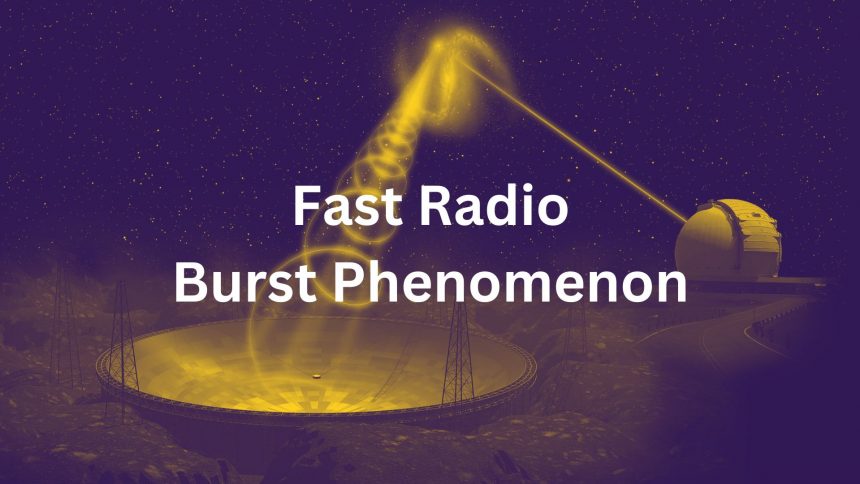
Across the vast expanse of the universe, fleeting bursts of radio energy erupt – these are Fast Radio Bursts (FRBs). Lasting mere milliseconds, these enigmatic signals pack a tremendous punch, releasing as much energy as the Sun does in an entire day. Yet, despite their growing number of detections, the true nature and origin of FRBs remain a captivating mystery. This article delves into the world of FRBs, exploring their discovery, characteristics, and the ongoing scientific quest to understand these celestial puzzles.
A Signal from the Unknown: The Discovery of Fast Radio Bursts
The first Fast Radio Burst was detected in 2001 by chance, while astronomers were sifting through archival pulsar survey data. This initial discovery was initially dismissed as an instrumental glitch. However, in 2007, a re-analysis of the data confirmed the existence of the enigmatic signal. Since then, advancements in radio telescopes and data processing techniques have led to the detection of hundreds of FRBs.
A Split Second of Brilliance: Characteristics of Fast Radio Bursts
Fast Radio Bursts are characterized by their extreme brevity. These bursts typically last for mere milliseconds, a fraction of a blink of an eye. Despite their fleeting nature, they pack a tremendous punch, releasing enormous amounts of energy in a short amount of time. Some FRBs can even outshine entire galaxies at their peak intensity. Additionally, FRBs exhibit a surprising degree of dispersion, meaning the lower frequencies of the signal arrive slightly later than the higher frequencies. This dispersion suggests that the signals travel through a medium filled with electrons, hinting at their passage through interstellar space or the atmospheres of their host objects.
A Universe of Possibilities: Theories on the Origin of FRBs
The origin of Fast Radio Bursts remains a topic of intense scientific debate. Here are some of the leading contenders:
- Magnetars: These are highly magnetized neutron stars with incredibly strong magnetic fields. Some theories propose that sudden and violent rearrangements within a magnetar’s magnetic field could generate a powerful burst of radio waves, potentially explaining FRBs.
- Merging Neutron Stars: When two neutron stars collide, a colossal release of energy occurs. This cataclysmic event could be responsible for some FRBs, particularly those observed to repeat at regular intervals.
- Black Hole Activity: The environment around supermassive black holes is a turbulent and energetic place. The accretion of matter onto a black hole or the disruption of a star by a black hole could potentially generate FRBs.
- Exotic Phenomena: Some theories delve into more exotic possibilities. For instance, cosmic strings, hypothetical defects in the fabric of spacetime, or even the birth of black holes could be responsible for FRBs.
Challenges in Detection and Identification: Unveiling the Secrets
Studying FRBs presents unique challenges:
- Fleeting Nature: Due to their short duration, pinpointing the exact location of an FRB within its host galaxy is difficult. This makes it challenging to identify the specific object responsible for the burst. It’s like trying to identify the source of a single firework explosion within a city at night – the fleeting nature of the event makes pinpointing the origin a challenge.
- Distance: Most FRBs originate from billions of light-years away, making detailed observations of their host environments difficult. The vast distances involved limit the amount of information we can glean about the FRB’s source through traditional telescopes.
- Diversity: Not all FRBs are created equal. Some FRBs appear to be one-time events, while others exhibit repeating patterns. This diversity suggests there might be multiple mechanisms responsible for Fast Radio Bursts generation.
Future Frontiers: Unveiling the Nature of FRBs
The quest to unravel the mysteries of FRBs is a multi-pronged approach:
- Next-Generation Radio Telescopes: The next generation of radio telescopes, with improved sensitivity and resolution, promises to detect fainter and more distant FRBs. These telescopes could also provide more precise localization of the bursts, enabling astronomers to pinpoint their origin within their host galaxies. Imagine having a more powerful telescope that can not only see fainter fireworks but also pinpoint the exact location where they originate within a city – next-generation telescopes offer similar advancements for FRB studies.
- Multi-Wavelength Observations: Coordinating observations with telescopes that operate across different wavelengths of light, such as X-ray and optical telescopes, could provide valuable clues about the environment surrounding the FRB source. This approach is like using different colored flashlights to examine the scene of a crime – each wavelength can reveal different aspects of the environment.
- Theoretical Modeling: Developing and refining theoretical models of the proposed Fast Radio Bursts generation mechanisms can help us understand the physical processes at play. These models can be used to predict the expected properties of FRBs and guide future observations.
The Allure of the Unknown: A Beacon for Discovery
Fast Radio Bursts serve as a captivating reminder of the vast unknowns that still reside within the cosmos. They represent a tantalizing glimpse into energetic and exotic phenomena occurring across the universe. The ongoing quest to understand Fast Radio Bursts is not just about unraveling the mysteries of these fleeting signals; it’s about pushing the boundaries of our knowledge of the universe’s most extreme environments and the fundamental laws of physics.
See Also: Hubble Space Telescope, A Beacon of Discovery Amidst Cosmic Mystery (blogtech.net)
Conclusion: A Universe Rich with Mysteries
The mystery of Fast Radio Bursts exemplifies the beauty and complexity of the universe. It reminds us that there’s still so much to learn about the cosmos, and every new discovery opens doors to even more profound questions. As we continue to explore the universe with advanced technologies and innovative approaches, the secrets of FRBs, and countless other cosmic enigmas, may eventually be revealed.