


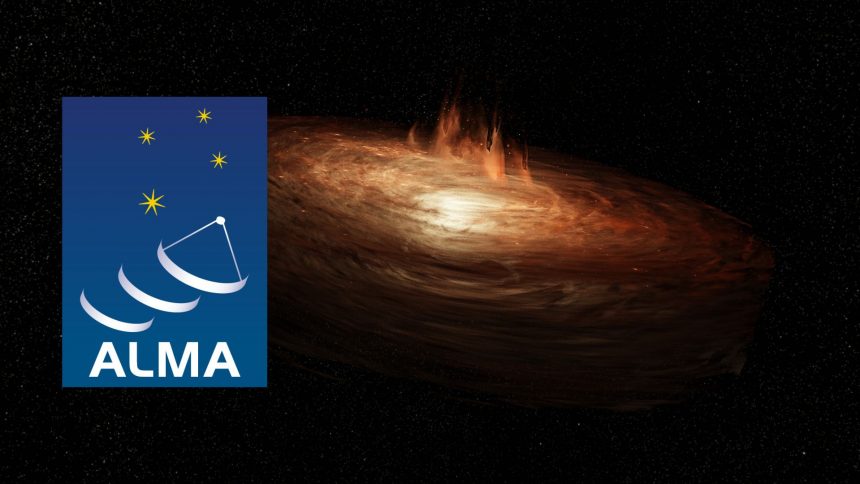
The early universe, a mere billion years after the Big Bang, was a tumultuous cauldron of activity. Galaxies were in their nascent stages, brimming with potential for star formation. However, recent observations by the Atacama Large Millimeter/submillimeter Array (ALMA), the world’s most powerful telescope of its kind, have shed light on a surprising phenomenon – how ancient, supermassive black holes residing in the hearts of these young galaxies actively suppressed star formation.
ALMA’s Keen Eye: Peering into the Distant Past
ALMA, perched high in the Atacama desert of Chile, is an array of radio telescopes operating at millimeter and submillimeter wavelengths. This allows it to peer through the dust and gas that often obscure the view of young galaxies and nascent stars in the early universe. In 2024, a team of astronomers used ALMA to observe a specific galaxy, J2054-0005, a staggering 12.8 billion light-years away. This object represents a time capsule, showcasing the universe as it was just one billion years old.
J2054-0005: A Galaxy in Quasar’s Shadow
What made J2054-0005 particularly interesting was the presence of a quasar at its center. Quasars are incredibly luminous objects powered by supermassive black holes actively accreting matter. This accretion process releases tremendous energy, making quasars some of the brightest objects in the universe. However, ALMA’s observations revealed a crucial detail: J2054-0005’s quasar wasn’t just radiating immense energy; it was also spewing out a powerful outflow of molecular gas.
The Outflow’s Impact: Stifling Stellar Birth
The molecular gas observed by ALMA plays a critical role in star formation. It serves as the raw material from which stars condense and ignite. However, the quasar’s powerful outflow was pushing this gas away from the central regions of the galaxy, effectively starving these regions of the fuel needed for star formation. This discovery confirmed a long-held theoretical prediction – that the powerful winds from quasars could stifle star formation in their host galaxies.
Before and After: A Tale of Two Galaxies
To understand the impact of quasar activity on star formation, astronomers compared J2054-0005 with another galaxy, also observed by ALMA, at a similar distance. This comparison galaxy, lacking a central quasar, displayed vigorous star formation activity. This stark contrast further highlighted the suppressive effect of quasar outflows on stellar birth.
ALMA’s Multifaceted Approach: Unveiling the Outflow’s Composition
One of the strengths of ALMA lies in its ability to detect specific molecular fingerprints within the gas it observes. In the case of J2054-0005, ALMA identified the presence of hydroxyl (OH) gas within the quasar’s outflow. This finding provided valuable insights into the composition and temperature of the outflow, allowing scientists to better understand the dynamics at play.
Cosmic Winds: Shaping Galaxy Evolution
The discovery of quasar outflows suppressing star formation has significant implications for our understanding of galaxy evolution. In the early universe, when quasars were more abundant, their activity may have played a crucial role in shaping the development of young galaxies. By regulating the rate of star formation, quasar outflows could have influenced the morphology, stellar populations, and overall mass of these nascent galaxies.
Beyond J2054-0005: A Universal Phenomenon?
J2054-0005 serves as a powerful example of how quasars can stifle star formation. However, astronomers believe this phenomenon may be more widespread. ALMA is currently engaged in observing other distant galaxies with quasars at their cores, aiming to confirm if this is a universal process in the early universe.
See Also: Meta Quest Pro Unbelievable Immersive Privacy Experience (blogtech.net)
Future Observations: Unveiling the Full Story
Further observations with ALMA, potentially coupled with data from upcoming space telescopes like the James Webb Space Telescope, could shed even more light on this fascinating phenomenon. By studying the properties of quasar outflows and their impact on the surrounding gas, astronomers can gain a deeper understanding of the complex interplay between supermassive black holes, star formation, and galaxy evolution in the early universe.
Simulations and Modeling: Complementing Observations
Observations with telescopes like ALMA provide a crucial snapshot of the universe at various points in time. However, to fully understand the dynamics of quasar outflows and their impact on star formation, astronomers also rely on powerful computer simulations. These simulations model the complex interactions between gas, dust, and radiation, helping scientists elucidate the physical processes driving the observed phenomena.
From Distant Quasars to Nearby Galaxies: Echoes of the Past
The discovery of quasar-driven suppression of star formation not only sheds light on the early universe but also offers intriguing insights into processes within our own cosmic neighborhood. While quasars in nearby galaxies are much less energetic than their ancient counterparts, the observed outflows may still have a subtle influence on star formation rates. Studying these nearby galaxies with powerful outflows from supermassive black holes can provide valuable clues about how these processes may have played out in the early universe on a grander scale.
The Co-Evolution of Black Holes and Galaxies
The relationship between supermassive black holes and their host galaxies is a complex and intertwined one. Black holes can influence star formation through processes like quasar outflows, while the material accreted by the black hole can ultimately fuel its growth. ALMA’s observations provide a glimpse into this co-evolutionary dance, where the actions of the black hole can shape the galaxy’s development and vice versa.
The Quest for Life: Implications for Habitable Worlds
Understanding the processes that govern star formation in galaxies is crucial in the broader search for life beyond Earth. Galaxies with suppressed star formation rates may have fewer stars and potentially fewer planetary systems. Studying how quasars and their outflows impact star formation can inform our understanding of where and how habitable worlds might form in the universe.
A Beacon of Technological Advancement: ALMA’s Role in Unraveling Cosmic Mysteries
ALMA’s groundbreaking observations of J2054-0005 highlight the transformative power of cutting-edge technology in astronomy. Its ability to peer through dust and gas and detect faint molecular signatures allows scientists to study previously hidden aspects of the early universe. As ALMA continues to evolve and new telescopes like the James Webb Space Telescope come online, we can expect even more spectacular discoveries that rewrite our understanding of the cosmos.
Conclusion: A Symphony of Destruction and Creation
The discovery of quasar-driven suppression of star formation paints a nuanced picture of the early universe. While these colossal black holes unleashed immense energy, they also inadvertently stifled the birth of new stars in their host galaxies. This interplay between destruction and creation highlights the complex and dynamic nature of cosmic processes. ALMA, through its unparalleled capabilities, plays a pivotal role in unraveling these mysteries and providing a glimpse into the grand narrative of the universe’s evolution.