


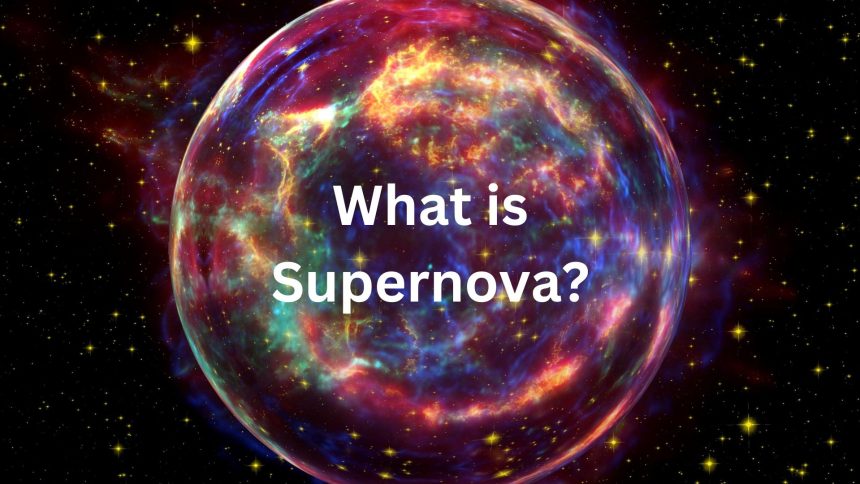
In the grand story of the cosmos, supernovae are dramatic turning points for stars, marking the end of one era and the beginning of another. These colossal explosions, often outshining entire galaxies at their peak, are a testament to the raw power and delicate balance at play within stars. Understanding this penomenon is crucial for piecing together the life cycle of stars, the creation of the elements that make up our world, and the evolution of galaxies throughout the universe.
The Final Act: When Massive Stars Go Supernova
Not all stars are destined to experience a supernova. These dazzling explosions are reserved for the most massive stars, those exceeding eight times the mass of our Sun. Throughout their lives, these stars fuse lighter elements at their cores, generating immense energy and pressure that counteracts their own gravity, maintaining a state of equilibrium. However, once the readily available fuel in the core is exhausted, the star’s fate takes a dramatic turn.
Without the outward pressure from nuclear fusion, gravity takes over, causing the star’s core to collapse in on itself within a mere seconds. This sudden collapse triggers a violent rebound, sending a shockwave outward that rips through the star’s remaining layers, propelling them into the surrounding space in a colossal explosion – the supernova.
The Two Flavors of Supernovae
There are primarily two types of supernovae, each with a distinct cause and outcome:
- Core-Collapse Supernovae: As described above, core-collapse supernovae occur when the core of a massive star can no longer support its own weight. The immense pressure and temperature during the collapse can trigger runaway nuclear fusion in the outer layers of the star, further fueling the explosion. Depending on the initial mass of the star, the core collapse can result in the formation of a neutron star, an incredibly dense object packed with neutrons, or a black hole, where gravity is so strong that not even light can escape.
- Type Ia Supernovae: These supernovae involve a different scenario. They occur in binary star systems where one star is a white dwarf, the leftover core of a Sun-like star that has exhausted its nuclear fuel. If the white dwarf accumulates too much mass from its companion star through accretion, it can reach a critical point where runaway nuclear fusion ignites in the carbon and oxygen within the white dwarf. This thermonuclear explosion tears the white dwarf apart, resulting in a brilliant supernova but leaving no remnant behind.
The Symphony of Destruction
A supernova is not just a dazzling display of light; it’s a cosmic foundry that churns out the elements heavier than hydrogen and helium. During the explosion, the intense heat and pressure within the star’s core forge these elements, including the iron that makes up Earth’s core and the calcium in our bones. This star explosion are the primary source of the elements that make up planets, stars, and ultimately, life itself.
The ejected material from a supernova doesn’t simply dissipate into space. It forms an expanding shell called a supernova remnant, which can interact with the surrounding interstellar medium, triggering the formation of new stars and planetary systems. The shockwave from the explosion can also compress nearby gas clouds, igniting star formation within them.
Supernovae: A Beacon for Astronomers
The immense brightness of a supernova makes it a powerful tool for astronomers. These explosions can be seen from vast distances across the universe, allowing scientists to study the properties of distant galaxies and trace the history of star formation. It also provide valuable information about the structure and evolution of stars, helping us refine our understanding of stellar processes.
By studying the light curves, the changing brightness of it over time, and the spectra, the breakdown of light into its constituent wavelengths, astronomers can determine the type of explosion, the properties of the progenitor star, and the elements forged in the explosion.
The Search for Supernovae: Unveiling the Secrets of the Cosmos
Astronomers around the world are constantly on the lookout for new supernovae. Dedicated surveys scan the skies, searching for sudden brightening events in distant galaxies. Ground-based telescopes and space observatories work in tandem to capture the evolving light curve and spectrum of a newly discovered object.
The study of this universe bigges explosion holds immense promise for the future of astronomy. With the next generation of telescopes on the horizon, astronomers will be able to observe it in even greater detail, potentially revealing never-before-seen phenomena within the explosion itself. By studying the faint signals from these distant explosions, we can probe the fundamental physics governing the universe’s most energetic events.
Supernovae and the Fate of Our Own Galaxy
Supernovae have enriched the interstellar medium with heavy elements, paving the way for the formation of our solar system and the planets within it. Additionally, the shockwaves from supernovae may have triggered the formation of our Sun itself.
While a supernova within a few dozen light-years of Earth is unlikely in the foreseeable future, astronomers are constantly monitoring massive stars within our galaxy that are potential candidates for it. Studying these stars and their environments can help us understand the precursors to a star explosion and potentially refine our ability to predict these events.
The Implication of Supernovae for the Search for Extraterrestrial Life
The quest for life beyond Earth goes hand-in-hand with understanding it. The intense radiation and shockwaves from a nearby explosion can be detrimental to life on any planets within the affected region. Studying the distribution of this stellar phenomena and their potential impact on planetary systems is crucial for identifying regions in the galaxy that might be more favorable for life to arise and persist.
See Also: A Beginner’s Guide to Virtual Private Networks (blogtech.net)
Supernovae: A Testament to the Universe’s Dynamism
Supernovae are a stark reminder of the dynamic nature of the universe. These colossal explosions mark the transformation of stars, the creation of new elements, and the potential birth of new generations of stars and planetary systems. By unraveling the mysteries of it, we gain a deeper appreciation for the delicate balance of forces within stars, the intricate workings of galaxies, and the ongoing story of the cosmos.